
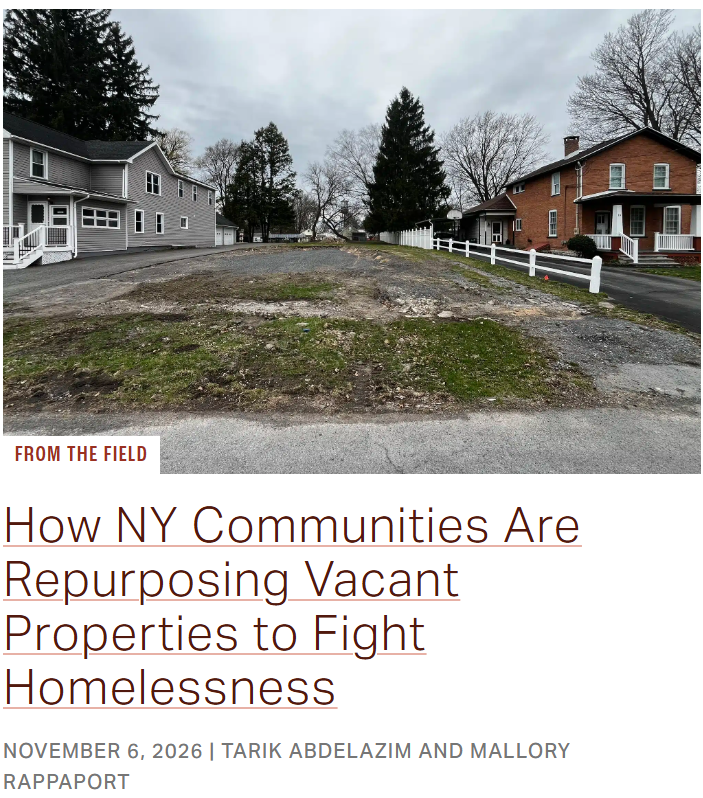
This fall, I co-authored an article with my former colleague at Center for Community Progress (I left, she’s still there), about our experience and work in New York helping local leaders leverage vacant properties as one solution (among many) to reduce homelessness. The article was published this month by Shelterforce, an award-winning news organization with a strong focus on housing justice, as part of their national ‘spotlight series’ on homelessness. You can check it out here.
As some of you know, I prefer long-form over short-form commentary (a clever way to say I’m wordy). In order to comply with Shelterforce’s reasonable word limit, we had to trim our original draft quite a bit. We decided to pull the recommendations that are very specific to New York, since this news organization has a national (and international) audience. For those interested, I’m sharing those recommendations below, which as expressed are mine entirely and do not reflect the position of my former organization.
Before the recommendations, I also include a brief section form the draft introduction that showcases how insane our current approach to homelessness is, and how our current solutions are mostly misaligned with the root cause of our crisis: systemic poverty amidst a booming rental housing market.
BRIEF EXPLANATION OF THE PROBLEM
…An investigative report by ProPublica and New York Focus in June 2025 centered Broome County’s crisis, but their reporting found similar trends statewide. According to their findings, county social service agencies outside of New York City placed just under half of the 34,000 families and individuals in need of emergency housing in hotels—up from 29% in 2018. They also found that the amount of money paid statewide to hotels for emergency housing in 2024 totaled $110 million, triple what was spent in 2018.
Other reporting and analyses have corroborated these findings. New York State Comptroller Thomas DiNapoli released a report in January 2025 documenting how New Yorkers experiencing homelessness doubled in recent years. Between January 2023 and January 2024, homelessness in New York State jumped 53.1 percent—more than four times the rate in the rest of the nation. While New York City’s homelessness spike played a large role in the numbers, the report found the surge was statewide. For example, rates in western New York (Buffalo and surrounding counties) spiked 81% and in the Southern Tier, which includes Broome County, they jumped 66%.
Pattern for Progress, a nonprofit think tank with a focus on the Hudson Valley region, released an eye-popping analysis in October 2024 of the costly reliance on hotels for emergency housing by four counties in its service area. The report highlighted the design flaws of a state and county delivery system that ends up paying far more to warehouse displaced residents in motels than it spends on helping vulnerable families and individuals remain securely housed in rental units.
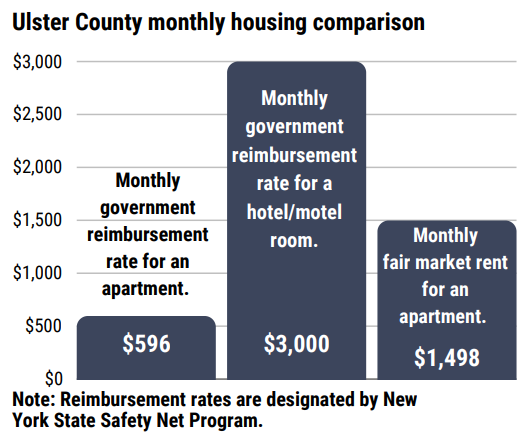
Source: “When Hotels Become Home,” Pattern for Progress, Oct 2024.
The Center for Community Progress published a similar analysis in February 2025 of emergency housing trends in six rural counties in upstate New York on behalf of the New York Land Bank Association. Our analysis found that this problem is not exclusive to urban centers and cities. Overall, the eight rural counties—some of which had no shelters other than a couple hotels or motels—saw homelessness surging, hotel placement as the new norm, the average length of hotel stays increasing, and local costs skyrocketing.
These trends started to pick-up pace in 2022 following the expiration of the state’s eviction moratorium in January of that year. One of the motel residents profiled in the Pattern for Progress report demonstrated how policies and the market conspired to fuel the current homelessness crisis. Her family had two full-time workers and had rented for years in Kingston, NY, without incident. But the expiration of the State’s eviction moratorium in January 2022 caused havoc, as the landlord saw a skyrocketing rental market and evicted her family to bring in new tenants that could pay higher rents. With no affordable options, she ended up in a motel and had been there for a couple years when interviewed. She still works and can cover a $1,000 rent, but the local rental market has rocketed past that price point and left her and many others stranded at a motel outside Kingston—all of them referrals from Ulster County DSS.
So while the regulatory restrictions of various federal and state funds compromise the ability of county DSS agencies to cost-effectively and efficiently help insecure households maintain or find permanent housing, the multitude of studies point to the main drivers of homelessness here (and elsewhere). More than anything, this is a crisis rooted in widespread poverty and housing affordability. And emergency placements in hotels have become the default solution to help poor households priced out of booming rental markets.
WHAT’S NEXT FOR NEW YORK?
Among the many reports, there are a number of takeaways and suggestions when it comes to tackling the state’s emergency housing crisis with more intention and conviction. Here are a few.
RECOMMENDATION #1. Map the Regs: Make Cheaper Supportive and Permanent Rental Housing an Eligible Alternative to Costly Emergency Housing at Hotels.
All of the reports mentioned in this article include local practitioners and officials pointing to the suffocating regulatory barriers that come with emergency housing funding. It is a real challenge. The mix of various federal and state funds that counties use to support different constituencies experiencing homelessness (individuals, families, Medicaid-eligible, Veterans, those with disability, etc.) make it nearly impossible to design local programs that prioritize cost-effectiveness, efficiency, and convenience for all residents in need.
What’s oddly missing, though, is a detailed forensic of which specific federal or state statutes and regulations are imposing the greatest barriers and why. A service system that can provide no more than $400 a month (approximately) to help a poor family in Broome County remain securely housed in a private or nonprofit rental, but is permitted to burn through more than $2,000 a month to shelter that same displaced family in a private motel for years ought to be dismantled and reformed. But without a clear forensic analysis and mapping of the federal and state funds and programs—administered by counties—it is hard to identify the exact reforms needed (and at which level of government).
Where reforms are not possible, mapping the barriers would also help New York State design and pilot new programs to “fill the gaps,” such as diversion programs that are preventative (helping a vulnerable family out before a homelessness event). The State ought to fund and oversee a highly technical and legal analysis working with a coalition of county DSS leaders and practitioners and create a clear blueprint for policy reforms and new program design at both the federal and state levels (and county level if needed) that would give the counties flexibility to direct preventative and emergency housing resources more effectively and efficiently.
RECOMMENDATION #2. Raise the Housing Allowance to Promote Security and Prevent Homelessness.
In the interim, the State should increase the public housing assistance levels for low-income and vulnerable populations, which have not budged in decades. This summer, a couple of statewide and regional nonprofits have filed a lawsuit against the State to compel such a change. The State hasn’t increased the housing allowance for families since 2003, and the allowance for individuals has been nearly the same for 40 years.
Would increasing the housing allowances save more in state funds used for emergency housing at motels? An underutilized program by the State seems to suggest it would save tax dollars and improve outcomes. The State’s Public Assistance Supplemental Shelter (PASS) program is an opt-in program for counties that allows eligible families and individuals to receive up to 85% of the region’s fair market rent in housing allowance. Housing advocates interviewed for this article state that counties that have participated have not only saved local tax dollars but have seen reductions in hotel placements and unhoused populations. Chautauqua County announced in April 2025 they had opted-in to the PASS program and estimated annual local cost savings of more than $2.5 million once fully implemented.
This is exactly the kind of program that gets to the heart of the problem: systemic poverty amidst a rental housing market boom. Creating a similar “supplemental voucher” program for housing insecure renters before they experience homelessness would be a wise next investment for both the State and individual counties.
RECOMMENDATION #3. Leverage VAD Properties and Land Banks.
Every year, some VAD properties fall behind on local taxes and end up in property tax foreclosure. Local and county governments traditionally auctioned off properties, but the outcomes were unpredictable and rarely positive for neighborhoods. In 2011, New York State passed land bank legislation authorizing any foreclosing governmental unit to create a land bank to help steward and resolve deteriorated tax-foreclosed properties, an alternative to the auction in a sense. There are now more than 30 land banks operating in the state.
A report our organization published in partnership with the New York Land Bank Association documented how land banks delivered exceptional outcomes for New York communities from 2013 to 2024. This work needs to continue. Over the last few years, two factors—the housing market boom and a US Supreme Court ruling that compelled reforms to the State’s tax foreclosure practices—have narrowed the pool of tax-foreclosed properties and made acquisition more costly. But the strategy of resourcing land banks to acquire as many tax-foreclosed properties as possible to deliver deeply affordable housing units must continue—and even expand. Counties should even consider the ‘Syracuse model,’ in which every property that the City of Syracuse forecloses on automatically goes directly to the Syracuse Land Bank, skipping the auction altogether.
RECOMMENDATION #4. Let’s Meet the Moment: Prioritize Permanently Affordable Housing and/or Social Housing.
The last few years have shown us that real estate markets can roar back unexpectedly, production of new units can stall, and far too many residents get harmed. Now, most communities across New York are prioritizing the production of affordable housing and paying far more than they did years ago for each unit. The level of public investment needed to produce more units is significant, and repeating our strategies of the past will be unwise. Local governments and state grant programs need to prioritize permanent and deeply affordable housing or champion proudly and openly a return to social housing.
The free market has never and will never provide housing for those families and individuals that are very low-income, extremely low-income, or homeless. Thus, public investments today shouldn’t deliver just a few years of affordable housing—and leave the next generation with another housing crisis that is even more expensive to fix (again). Plans to decommodify a small segment of housing in every community should not be a controversial goal—but it will remain a powerful bogeyman of the free market apostles as long as housing justice advocates tip-toe around this topic or concede to incremental reforms.
Fortunately, New York’s statewide coalition of housing advocates, Housing Justice for All, is meeting the moment. The legislative proposal to create a statewide social housing authority needs to be understood as one of the many solutions that can help resolve the profound homelessness crisis in New York.
Final Thoughts
New York’s reliance on hotels is both a blessing and a curse. According to HUD’s 2025 Annual Homeless Assessment Report, New York has the highest rate in the country of homelessness per 100,000 residents. New York also has the lowest rate in the country of unsheltered population because of its commitment to provide emergency housing through its robust ecosystem of shelters, including hotels and motels. It is important to acknowledge this is a good thing, given these people would otherwise be sleeping in cars, under bridges, or worse. However, the State’s approach has become a costly, ineffective, reactive solution to the underlying systemic problems of poverty and housing affordability, key drivers of homelessness.
New York also has a unique reliance on county DSS agencies as a ‘single-point of entry’ for those experiencing homelessness. Advocates interviewed for this article see promise and potential of this locally-administered system if leveraged and reimagined appropriately, with more resources, staffing, flexibility, and new discretionary preventative programs.
The crisis is real, but so too are the chances for meaningful reform to policies, practices, and programs. New York can and must do better. With a deeper and more intentional collaboration across all levels of governments to not just solve homelessness but advance housing justice for all, New York can offer the country a blueprint for success.
Tarik Abdelazim is a local advocate for housing justice, racial justice, and good governance. For 12 years, Abdelazim honed his policy expertise helping urban and rural communities across the country tackle vacancy and disinvestment as a senior leader with the Center for Community Progress. Prior to his national work, Abdelazim served in Binghamton’s City Hall from 2006 through 2013 as the Deputy Mayor and then the former Director of Planning, Housing, and Community Development. Abdelazim is a frequent contributor to this site.