
A public budget can be an honest effort to balance financial reality with an administration’s values, or a magician’s hat that entertains the audience with theater and deception. Election year budgets are mostly the latter, and Kraham’s proposed budget uses the most common budget tricks and gimmicks to project a curated image that helps his re-election efforts.
I write this having crafted four Binghamton annual budgets as Deputy Mayor, and supporting the development, to varying degrees, of another four budgets. Since we inherited a city on the brink of bankruptcy and financial ruin, I quickly developed a strong aversion to budget gimmicks and tricks for personal political advantage.
As I’ve done in many years past, I’m providing a summary of some of the most notable budget features for those who still care about democracy and like to exercise their civic muscle.
First, a budget overview.
WHAT MAKES UP THE BUDGET?
The annual budget for City of Binghamton is made up of multiple funds. The primary and most important fund is the GENERAL FUND. This funds covers most of our basic municipal services. The money that we collect each year in property taxes is what covers the “gap” between the estimated revenues and expenses in our general fund.
In addition to the primary GENERAL FUND, there are six separate, individual “enterprise” or “special” funds:
- Sewer
- Water
- Refuse
- Parking
- Golf
- Insurance
These funds are usually tied to a specific service that is covered by a “user fee.” The user fees don’t always cover the costs of the service, like in the Refuse Fund. At times, these smaller enterprise funds accrue deficits, and local tax dollars are used in some fashion or another to cover shortfalls. Thus, you often see in the mayor’s annual proposed budgets transfers from the general fund to some of these local funds (or vice versa—like I said, a magician’s hat) to deal with emerging, short-term trends. For instance, local taxpayers have contributed hundreds of thousands of dollars to the golf fund in the last few years to help cover repairs and upgrades because “user fees” weren’t sufficient to maintain and upgrade the Ely Park public course.
Finally, there are a few more special funds that are created to track unique funding sources and unique funding rules. These are the multi-year Capital Fund (all the local funds, grants, and bonding proceeds that support investments in our infrastructure assets) and the multi-year funds specific to each US HUD annual grant program, like Community Development Block Grant, HOME, and Emergency Solutions Grant.
TWO GIMMICKS TO THE BUDGET PROCESS
All proposed fund budgets need to be balanced, because local governments are expressly prohibited from carrying debt like the federal government. Each year, a mayor will estimate all the revenue lines and all the expense lines, which produces a clear view of the “gap” or deficit to achieve a balance budget.
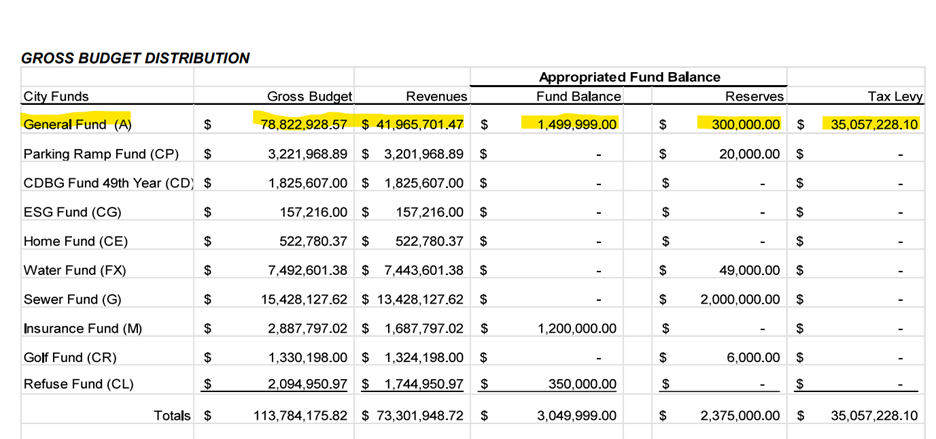
Above is a screenshot of the fund summary page in Kraham’s 2026 proposed budget. His general fund expenses exceed his revenues by almost $37,000,000 (not unusual). At this point, he can decide to use some funds from the “piggyback” to help reduce what the local taxpayers need to pick up. According to the above, he uses about $1.8 million from the city’s “piggybank” to lower the amount needed to collect from all local taxpayers. If there were no savings in the general fund piggybank, Kraham would have to raise taxes about 5% to raise that $1.8 million.
In other words, the amount of money to be raised through local taxes (called the tax levy) is the LAST number calculated in every budget process.
[Sidenote: The tax levy is then sent to the Comptroller to figure out how much every $1,000 in assessed value must pay to get us to the total tax levy. Which is why when downtown and student rental properties are seriously underassessed, the distribution of the tax levy is wildly unfair, and burdens homeowners the most. And why I’ve been arguing for more than a decade that we need a citywide reassessment, something we haven’t done since 1993 and something that would bring SIGNIFICANT tax relief to homeowners when completed.]
Budget Gimmick #1: Raid the Piggybank
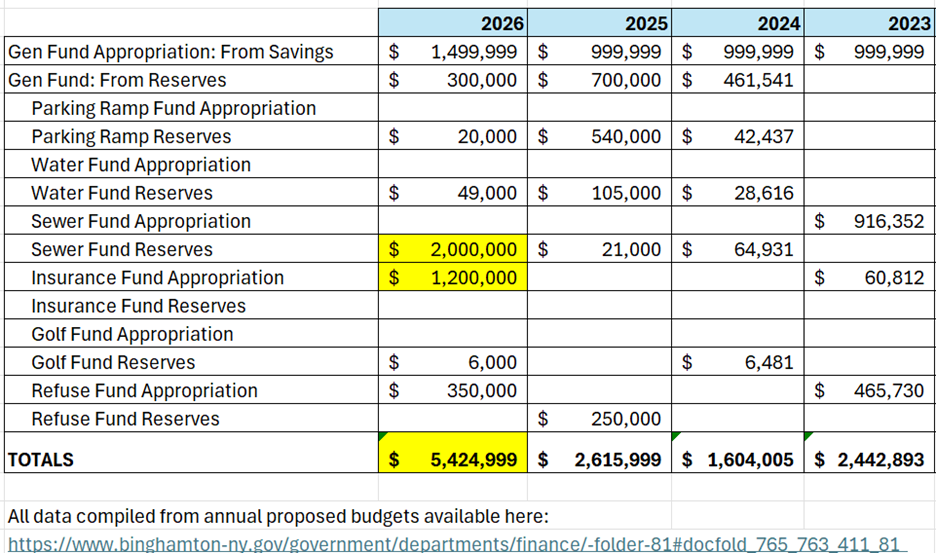
The mayor is using fund balance appropriations and reserves to ‘mask over’ what should likely be a slightly higher tax increase to maintain fiscal responsibility. I learned early on in my public service tenure that this is a common budget trick used by sitting executives (“politicians”) during an election year: use piggy bank reserves to reduce the tax levy.
The table below shows how the amount being committed to close the gap across all funds is significantly higher than prior years (the amount committed for the 2026 budget is just under 2.5 X the average amount used in his three previous budgets). Kraham is clearly using this budget trick to “get through an election season.” After all, every dollar you can appropriate from the piggybank is one dollar you don’t have to raise via local property taxes.
Budget Gimmick #2: Inflate Revenue Projections
Another common ‘budget trick’ to keep taxes low is simply to increase estimated revenue lines, way beyond what trends from prior years suggest. A few examples include:
- Increasing sales tax revenue substantially, projecting nearly $18M in 2026 when that number was $16.64M in his 2025 budget and $16M in his 2024 budget
- Increasing hotel/motel occupancy tax revenue by 20%, from $500,000 to $600,000 despite the collections through August 2025 are significantly lower than both projections
- Increasing the money collected from parking tickets by nearly 20%, from $525,000 to $630,000
Just these three unusually large bumps in year-over-year revenue projections is equivalent to raising property taxes more than 4%. Using both primary budget gimmicks—raiding the piggybank and unreasonable inflation of revenue projections—saves Kraham from having to raise local property taxes about 10%.
To be clear, the City is in a strong financial position and we can weather one year of budget gimmicks and tricks. But it’s worth calling out the mayor’s choices, which is to prioritize his re-election campaign over the long-term financial health of Binghamton’s finances.
Here are some other notable items the Council should inquire about and contemplate as it reviews, potentially amends, and approves a final 2026 budget:
- In the Revenue section (page 12) there are some unusual amounts included in the INTERFUND REVENUES line, specifically the $775,501 in “Refuse Fund Support” and the $545,000 in “Sewer Project Chargeback 2015-2023.” I’ve never seen these before, and this line jumped from $1.92M to $2.95M. Something is off, and as mentioned above, this one-time jump of a million dollars alone helps avoid a more than 3% tax increase. Council needs to inquire about these numbers. If it’s legitimate, cool. But this tracks with the “gimmicks” of inflated revenue lines described above.
- In the Revenue Section under Payment In Lieu of Taxes (page 7), I have two questions:
- Boscovs used to make an annual payment to the City of about $60,000, but this budget (and last year’s budget) no longer includes that. Why? City taxpayers (through the Binghamton Local Development Corporation) literally own the building and lease it to Boscovs. Why is the tenant no longer making a payment, especially when we just built them a $25,000,000 parking garage (using $7,000,000 of pandemic recovery funds)?
- Why is the Metrocenter, privately-owned by Justin Marchuska, receiving a PILOT that cuts their local tax liability by nearly 40%? According to online records, the property has an URBAN RENEWAL tax exemption for the full assessed value of $2,300,000. Marchuska bought the property in 2017 for $3.2 million, and listed the property for sale this June (2025), with an asking price of $21 million. Please ask the Assessor to justify this urban renewal exemption when online guidance from the NYS Department of Taxation and Finance suggests that this specific exemption requires demolition, significant rehabilitation, or new construction consistent with an ‘urban development action area plan.’ Marchuska purchased the occupied, stable property in 2017. I just don’t understand why this local wealthy developer gets a tax break on a property he’s hoping to sell for 7X what he paid for it less than ten years ago. Council, please ask.
- The budget for the Legal Department doubles. This might actually save money based on this administration’s reliance on outside firms for a number of legal actions (including eminent domain case, Binghamton Plaza) that have totaled close to a million dollars. The prior Corporation Counsel, Sophie Bergman, was WAY over her head and cost taxpayers a TON of money in private law firm fees.
- In the IT budget, there are two substantial increases year over year that caught my attention: (a) Public Safety HW/SW increased from $503K in 2025 to $675,000 in 2026. Why? (b) Citywide went from $290K to $532,000. Why? These are not “small increases,” and worth digging into.
- The summary (total) page for the Police Department is missing (should be between pages 65 and 66). Never seen that before!
- The Fire Department budget is 8.4% higher than last year. At times, this happens. Union contracts aren’t solved for a few years, and then when an agreement is reached, payouts of multiple years of wage increases and other benefits are suddenly included in the next year’s budget. If this significant increase is due to such circumstances, then nothing to note here. It’s reasonable, and a worthy investment in our first responders. But I’d ask about it.
- Bond Anticipation Notes (BANs). These are ‘short-term borrowing’ instruments cities use before they negotiate and enter into long-term bonds. But the amount of the BANs are no more than $1.5 M, yet we incur more than $1 M in interest. If we have such a healthy general fund balance, why are we even using these short-term borrowing instruments that cost us almost twice the amount we’re borrowing? If we can use general fund reserves as a bridge to get us to the bonds, it would save local taxpayers one million a year.
- Vacant Executive Positions. There are key positions vacant, including Commissioner of Public Works, Deputy Engineer, and Commissioner of Parks.
- New Positions. This budget proposes the addition of 10 new positions. While five are in public works and mostly lower-level positions, the others are: (1) Assistant Corporation Counsel; (2) Paralegal; (3) Assistant Attorney (Code Enforcement); (4) Deputy Treasurer; and (5) Grants Administrator.
I am confident in these initial observations, but as always, the budget can be a “magician’s hat” for those who don’t prioritize transparency and honesty. Given Jared Kraham’s history of duplicity and opaqueness, take my observations with a grain of salt. But please know that any numbers referenced in this article, including the table above, are based on city budgets available online, double-checked, and 100% accurate.
I encourage citizens to either participate or watch the ongoing budget hearings, the schedule of which can be found at Binghamton’s online Calendar (https://www.binghamton-ny.gov/community/calendar-month-view).
Tarik Abdelazim served as Binghamton’s Deputy Mayor and then the Director of Planning, Housing, and Community Development from 2006-2013. He remains actively engaged as a citizen and good government watchdog in his free time, and reports on the annual budget process nearly every year.