
Biden’s American Rescue Recovery Act, the administration’s signature policy response to the COVID pandemic, included $350 billion to be distributed among every governmental unit, territory, and tribal nation in the country. The awards were announced in the spring of 2021, with deadlines of allocating all funds by December 31, 2024 and spending all funds by December 31, 2026.
I suspect many residents are unaware that the three largest units of government in Broome—the City of Binghamton ($46.2 M), Broome County ($35.8 M), and the Town of Union ($30.1 M)—were awarded a total of $113,662,373 to invest in people and places impacted by COVID.
This article analyzes what these three governments chose to fund with more than $113 million of pandemic recovery funds. The four executives in charge who had discretion and authority over how to manage and spend this unprecedented sum of flexible, recovery dollars include Binghamton Mayors Rich David and Jared Kraham, Broome County Executive Jason Garnar, and Town of Union Supervisor Rob Mack.
The findings are despairing, particularly as we contend with spiking costs for groceries and utilities, an acute affordable housing crisis, sweeps of homeless encampments, and the recent murder of a homeless individual by a group of young teenagers.
This first section of this article reminds readers of the purpose of ARPA, based on the US Treasury’s program rules. The second section summarizes ARPA spending by Binghamton, Broome, and Union, which come directly from reports submitted by these governments to the US Treasury Department (and made available online for civic nerds like me). The third and final section offers two timely personal reflections, which are critical of not only what our local governments spent funds on, but how they failed miserably in managing and implementing this unprecedented opportunity.
Section 1. What was the purpose of ARPA?
Biden’s pandemic recovery plan included $350 billion in ARPA funds that were allocated to every local governmental unit in the United States, including tribal nations and territories. The program was managed by the US Treasury Department. The program was incredibly flexible, allowing local leaders to tailor recovery investment plans to their specific needs.
ARPA established a few initial core objectives that defined eligible uses, in that funds could be used to:
- Respond to the public health and negative economic impacts of the pandemic
- Provide premium pay to essential workers
- Provide government services to the extent of revenue loss due to the pandemic
- Make necessary investments in water, sewer, and broadband infrastructure
A few more additional objectives were added when many local, county, and state officials seemed less interested to invest in people impacted by the pandemic and more interested in investing in buildings, things, and places. Thus, the rules were later amended to allow local and state governments to spend ARPA funds on disaster recovery (floods, tornadoes, fires, etc.) and transportation needs. The Biden administration, trying to seek balance, also added another objective: any activity that was allowed under HUD’s Community Development Block Grant program (CDBG, a program geared specifically to help poor people and poor neighborhoods) would be an eligible use of ARPA funds.
That original first objective (above) and Biden’s decision to include any CDBG-like activities as eligible were a very bright greenlight for local leaders to think innovatively and freely for how to spend ARPA funds on people, tenants, workers, small businesses, and any other low-income or vulnerable populations disproportionately harmed by the pandemic—and the agencies that serve them.
Moreover, language was repeated throughout the initial program rules that governments should invest funds that not only helped address immediate needs, but also helped remedy historical inequities and those most impacted by past injustices (read: poor folks and Black folks).
The rules also encouraged strong community engagement, particularly efforts that centered those most impacted by COVID. The rules didn’t mandate local transparency, but there were plenty of clues of how the administration hoped local, county, and state leaders would approach this unprecedented opportunity.
Let’s see how the Big Three chose to spend these flexible, pandemic recovery funds.
Section 2. ARPA: Largely a Public Infrastructure Slush Fund for The Big Three in Broome
I pulled the most recent quarterly reports (Q3, 2025) from Binghamton, Broome, and Union that are available online at the US Treasury to compile this analysis. I aggregated the itemized entries into one spreadsheet, and then categorized each entry based on the project name and description. There were only a few entries among 213 ‘projects’ that were unclear how to categorize (I tagged them as unknown).
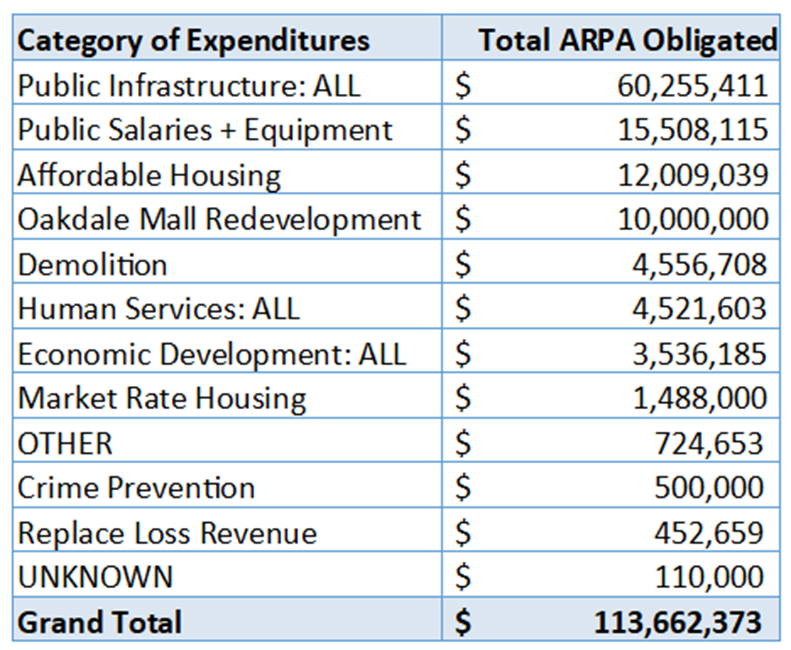
Table 1 below provides the highest-level summary of how the Big Three allocated more than $113,000,000 of ARPA funds.
Some of the key takeaways:
- More than half ($60.2 M) was spent on public infrastructure projects, like parks, sewer lines, or upgrading, repairing or constructing new public buildings.
- The second highest expenditure was on public salaries—primarily for fire and police—and purchasing public equipment, such as an ambulance, mowers, a snow plow, police vehicles, and IT hardware.
- Just as much was spent on market-rate housing and the Oakdale Mall redevelopment combined than on affordable housing.
- More than $4.5 M was spent on demolishing properties that we allowed irresponsible private owners to abandon and deteriorate (and some of that was used to pay them off).
Like, I said: it’s not pretty.
Below are two more tables that look a bit differently at the spending decisions of the Big Three. And for those who want to nerd out and sort the entire list of 212 entries, feel free to check out (and even download) this excel spreadsheet that is the source for these tables. I made it into a database that allows for easy sorting and review.
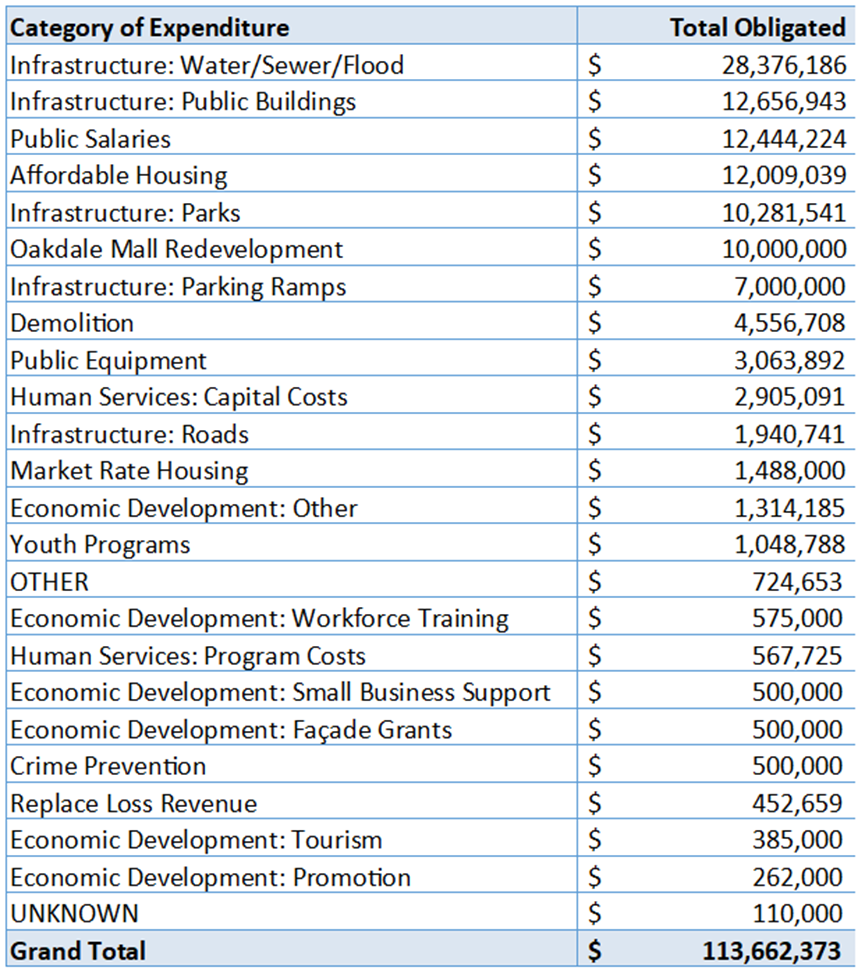
Table 2 is similar to the one above, but distinguishes a little bit among those investments in public infrastructure, human services, and economic development. For instance:
- The amount spent on human services in the table above includes ‘capital grants’ to nonprofits to help either acquire, expand, or rehab their buildings. When you pull out capital grants and look at how much ARPA was allocated to support expanding programs and services that helped address the urgent needs of vulnerable populations, including youth, the results are abysmal.
- Union spent 0.65% of its pandemic recovery grant on programs carried out by agencies that serve vulnerable populations.
- Broome County spent 1.02%.
- Binghamton took the “Crown of Caring” of the Big Three by spending a “whopping” 2% on this category.
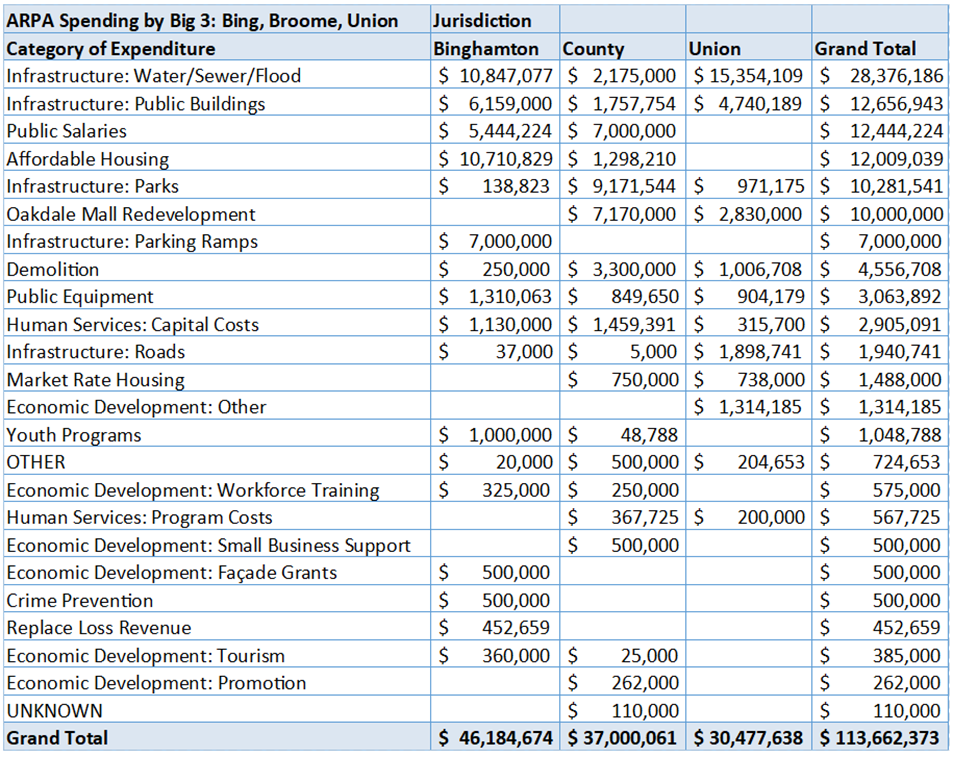
Finally, Table 3 breaks out the above categories by jurisdiction, which offers some new insights. For instance:
- Only Binghamton, under Kraham, allocated a meaningful amount to support youth programs.
- Prior tables indicate that nearly 10% of ARPA funds were committed to affordable housing by the Big Three. This table shows that Binghamton was responsible for most of it—and probably because of the strong advocacy by affordable housing advocates in Binghamton (some which now serve on City Council). The Town of Union didn’t commit one ARPA dollar to affordable housing, even though there are real needs for affordable housing in Johnson City and Endicott.
- Town of Union spent just over 50% of their ARPA dollars on water, sewer, and stormwater infrastructure.
- Broome spent 30% of their ARPA funds on public parks: major upgrades to county parks and small improvements to rural town parks.
- Binghamton spent 15% of their ARPA funds on parking ramps.
Section 3. My Two Timely Reflections
I offer these two timely reflections with our collective anger, confusion, and sadness surrounding the recent murder of a homeless person by a group of troubled, young teenagers.
Reflection #1: It’s Last Minute, But Not Too Late
ARPA was meant as a community recovery program in the face of an unprecedented pandemic, but the analysis shows that 67% was spent by local leaders on public infrastructure, public salaries, and public equipment.
The analysis also uncovered that as of September 30, 2025, according to reports submitted by the Big Three (Union, Binghamton, and County), just over $12 million of obligated ARPA funds remained unspent. Those numbers are from eight months ago, but I suspect local leaders still have the chance to re-allocate at least $1,000,000 of ARPA funds.
As we all reflect on the fatal attack of a homeless individual by a group of 14 and 15 year olds, now is the time for local leaders to put up or shut up with every last remaining ARPA dollar.
I imagine Garnar and Kraham will hand-wring over the spending deadline at year’s end, claim “options are limited,” and use the threat of losing federal funds as a way to beat back an honest and urgent conversation of possibilities. Wherever one sits on the political spectrum, we need to unite as a community and call that for what it is: lazy, irresponsible ‘leadership’ peddling excuses to steer the last of our recovery dollars to their own pet projects.
Here are a few ideas that I came up with half-asleep on the couch with my dog:
- Trump and the GOP-led Congress slashed food assistance to low-income folks in order to pay for tax breaks for billionaires. So use ARPA funds to enhance SNAP benefits at the local level. Provide every household already eligible for SNAP—low-income single mothers are number one recipient—with a cash boost of $200 per month to help with the crippling cost of groceries (and everything else).
- Data centers and corporate greed are causing utilities to skyrocket. Use ARPA funds to boost the housing assistance currently being provided by DSS to eligible tenants. There is already a “utility allowance” built in, so simply enhance it with ARPA dollars to help low-income families and individuals stay housed.
- Negotiate with fitness gyms, Rumble Ponies, and other recreational venues some ‘Summer 26 Youth Programs’ that allow youth to access their services for free or at a discounted rate. For instance, buy 100 tickets for every Rumble Ponies home game, which any youth with a valid middle school or high school ID can purchase for $2 on a first-come, first-served basis.
- Canvass all affordable housing agencies currently trying to bring rental properties online for very-low income tenants (at deeply affordable rents) and direct ARPA funds to fill any funding gaps or expedite completion.
Are these the best ideas? Nope. But they at least center those who have been largely overlooked these last five years by the four executives who directed $113 million in recovery funds elsewhere. Are there more ideas? Yeah, which leads to my second point.
Reflection #2: The Public Was Never Invited Once
I watched these funds closely over the years and I can say without a doubt that the four executives with authority over these recovery funds never once held an open community forum to educate and engage residents about this unprecedented opportunity. They never once used public surveys or diverse community advisory boards to invite constituent feedback. None of the Big Three even bothered to create a dedicated webpage or website, a basic administrative step in pursuit of transparency (and used by most upstate cities with a population above 50,000), to keep residents informed of ARPA spending.
The Big Three’s approach to more than $113 million in flexible federal funds was undemocratic, shameful, and insulting to the very intent and purpose of this recovery program.
Yeah, they invited some of their safe allies into their respective executive offices and discussed how to spend a portion of the funds. But that’s not the kind of transparent, inclusive decision-making process that so many other government leaders here in New York and across the country demonstrated with care and excellence.
Rich David had unexpected access to tens of millions of flexible recovery dollars in his last six months in office and he wasted no time leveraging it like a campaign slush fund. He was planning a run the following year for New York State Senator, and ARPA was a gift to lift his brand. In six months, David doled out nearly 60% of the City’s $46 million dollar recovery grant without a single community forum.
Jason Garnar and Rob Mack were no better, and similarly shut the public out of the decision-making process, treating ARPA as a “branding opportunity.” Mack directed millions to address stormwater infrastructure—his signature achievement—and Garnar got his chance to advance his brand as the “parks” guy, knowing such projects score well with prime voters from middle to upper class families in the suburbs.
Now is the chance for Kraham, Graham, and Mack to make (some) amends, as they look for timely ways to spend a small (but not insignificant) pot of unused ARPA funds.
INVITE COMMUNITY GROUPS AND PARTNERS TO IMMEDIATELY SUBMIT ONE-PAGE PROPOSALS FOR HOW TO USE THE ARPA FUNDS THIS SUMMER AND FALL.
These executives should put out guidance for how the funds could be used–and real guidance, not bullshit interpretations that intentionally limit options. They should allow for online submissions, and then host a community forum the last weekend in May and allow residents to vote on eligible projects that either center PEOPLE in need–such as low-income single mothers and seniors; youth; homeless individuals–or prioritize urgent needs, like the crippling costs of groceries, utilities, gas, and rent, and the need for affordable access to mental health services and support.
Because I’ll tell ya, the current proposal by Garnar to use ARPA funds to buy the worthless, demo-ready, tax-delinquent Vestal nursing home from a speculator from NJ hiding behind an LLC (and a likely accomplice to the criminal scam-artist, Anzaroot) is insanely irresponsible and roundly ridiculed by EVERY taxpayer and resident who learns about it.
And Kraham’s ongoing exploration of using the City’s remaining ARPA funds to tear down another parking ramp (State Street) shows such a profound lack of imagination and a callous disregard for real challenges in our community, some that prove fatal and tragic to people in need.
I won’t hold my breath, but this is the very least we should be demanding of Kraham, Garnar, and Mack.
And while I have so much more to say, I’d rather publish this now, unfinished. Besides, I hope others can carry on and deepen this much needed conversation. We’re all asking what we can do in the face of a shocking and brutal incident involving troubled youth and the death of an innocent man who deserved so much better.
I don’t know what exactly we as a community should do, but I know damn well that every last remaining ARPA dollar–every last one–should be earmarked for the “Peter Bennedum Memorial Initiative” and finally put to use consistent with the program’s ultimate and original goal: community recovery.